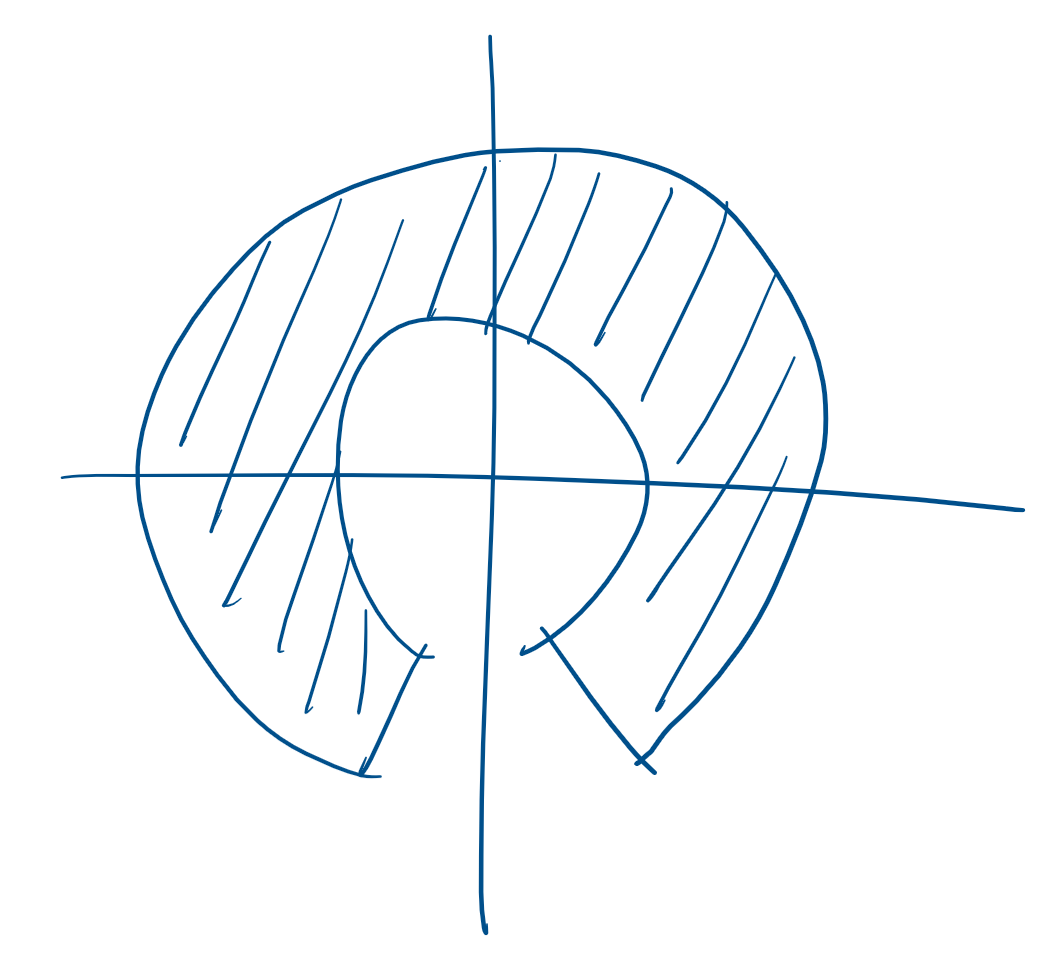
The inverse of the exponential! It’s probably too much to hope for \log = \log_e to be the inverse, because \exp is periodic (with period 2\pi i) in \mathbb C.
Begin with e^w = z. Write z = re^{i\Theta}, r > 0, where \Theta = \operatorname{Arg} z \in (-\pi, \pi].
We can make our calculations clearer by using polar coordinates in the domain and rectangular coordinates in the range. That is, w = u+iv \implies z=e^w = e^{u+iv}=e^ue^{iv}\\ \implies e^u = r,\quad v=\Theta + 2k\pi, \quad k \in \mathbb Z. So u = \ln r, which (notation in this course) means logarithm with base e of the positive real number r. Thus, \begin{aligned} w &= u+iv \\ &= \ln r + i(\Theta + 2k\pi) \quad k \in \mathbb Z \\ &= \ln |z| + i \arg z \end{aligned} This defines the multi-valued function \log : \mathbb C_* \to \mathbb C_*. \begin{aligned} \exp (\log z) &= z\\ \log(\exp z) &= z + 2k\pi i \end{aligned} We can check the the properties of \log translate into \mathbb C. For example, (note that this is a statement of multi-valued functions) - \log (z\xi) = \log z + \log \xi. - \log (z / \xi) = \log z - \log \xi.
As with \operatorname{Arg} and \arg, we can define the principal logarithm, denoted \operatorname{Log} : \mathbb C_* \to \mathbb C_*, as \operatorname{Log} z = \ln |z| + i \operatorname{Arg} z This function is single-valued but has the disadvantage of being discontinuous on the negative real axis and 0, since \operatorname{Arg} is discontinuous there. Indeed, \operatorname{Log} and \operatorname{Arg} are not even defined at 0.
As with \operatorname{Arg}, it may be the case that \operatorname{Log}(z_1 z_2) \ne \operatorname{Log} z_1 + \operatorname{Log} z_2.
Remark: In reals, we could define dsomething like 2^{\sqrt 2} as \lim_{n\to\infty}2^{a_n} where \{a_n\}\to\sqrt 2. This doesn’t quite work in complex.
Set z^c = \exp(c \log z). Because \log is multi-valued, this may result in a sequence of outputs. For c \in \mathbb N and 1/c \in \mathbb Z, we recover the formulas from the fourth lecture.
Remark: B.C. defines z^{1/n} as a multi-valued function and defines the principal value as \operatorname{PV}(z^{1/n}) = |z|^{1/n}\exp (i\operatorname{Arg} z / n). Similarly for z \mapsto z^c, \operatorname{PV}(z^{c}) = \exp(c \operatorname{Log} z) = \exp (c \ln |z| + ic \operatorname{Arg}a).
Example: As a concrete example, doable but easy to make mistakes, \begin{aligned} \operatorname{PV}[(1-i)^{4i}] &= \exp(4i (\ln |1-i| + i\operatorname{Arg}(1-i)))\\ &= \exp (4i \ln \sqrt 2 -4(-\pi/4))\\ &= e^{\pi}\exp(4i\ln \sqrt 2) \\ &= e^\pi (\cos(2\ln 2) + i\sin (2\ln 2)) \end{aligned}
Sometimes, we need to use a different single-valued \operatorname{Log} or \operatorname{Arg}. For example, if we need to integrate around a contour excluding the -i axis. In this case, we would define \operatorname{\mathcal {Arg}} z such that -\pi/2 < \arg z \le 3\pi/2. This leads to an alternative single-valued \mathcal {Log} and derived functions.
Next: square roots, branch cuts.